
Cook County Bench Warrants Explained
A Cook County bench warrant is a judge's order tied to a duty you already owe the court. Missing an appearance is the usual trigger. So is an unpaid fine, a skipped condition, or ignoring a summons. Minnesota case records may label it a warrant for failure to appear instead, so the words matter less than the missed event behind them. Note: A bench warrant is not a new criminal charge, though the missed appearance can carry consequences of its own.
How Cook County Bench Warrants Are Issued
A summons or citation is what creates the duty to show up. Skip it, and the court can issue process under the criminal rules and the failure-to-appear statutes. A Cook County district judge signs the warrant, and the record captures the missed date, the offense, any bail or conditions, and the direction to the sheriff or another authorized officer. Minnesota's official Form 8 is the application and warrant used after a failure to appear in response to a summons or citation. Its fields show exactly what the court records: the missed appearance date, the issuing officer, the prosecuting attorney, the offense, release conditions, the bail amount, and the judge's signature.
Missed Court Dates and Cook County Warrants
The paperwork behind a Cook County failure-to-appear warrant is standardized across Minnesota. Reading it tells you what the court already decided. The fields come from the official court form.
| Case and court | The district and file number the warrant attaches to |
|---|---|
| Missed date | The appearance the person did not attend |
| Issuing officer | The person who applied for the warrant |
| Prosecuting attorney | The office handling the case |
| Offense | The charge or citation behind the obligation |
| Release conditions and bail | What the court requires before release |
Minnesota Form 8 is the official document for Cook County cases. It is a court form, not a self-service recall form.
Cook County Sign-and-Release Warrants Explained
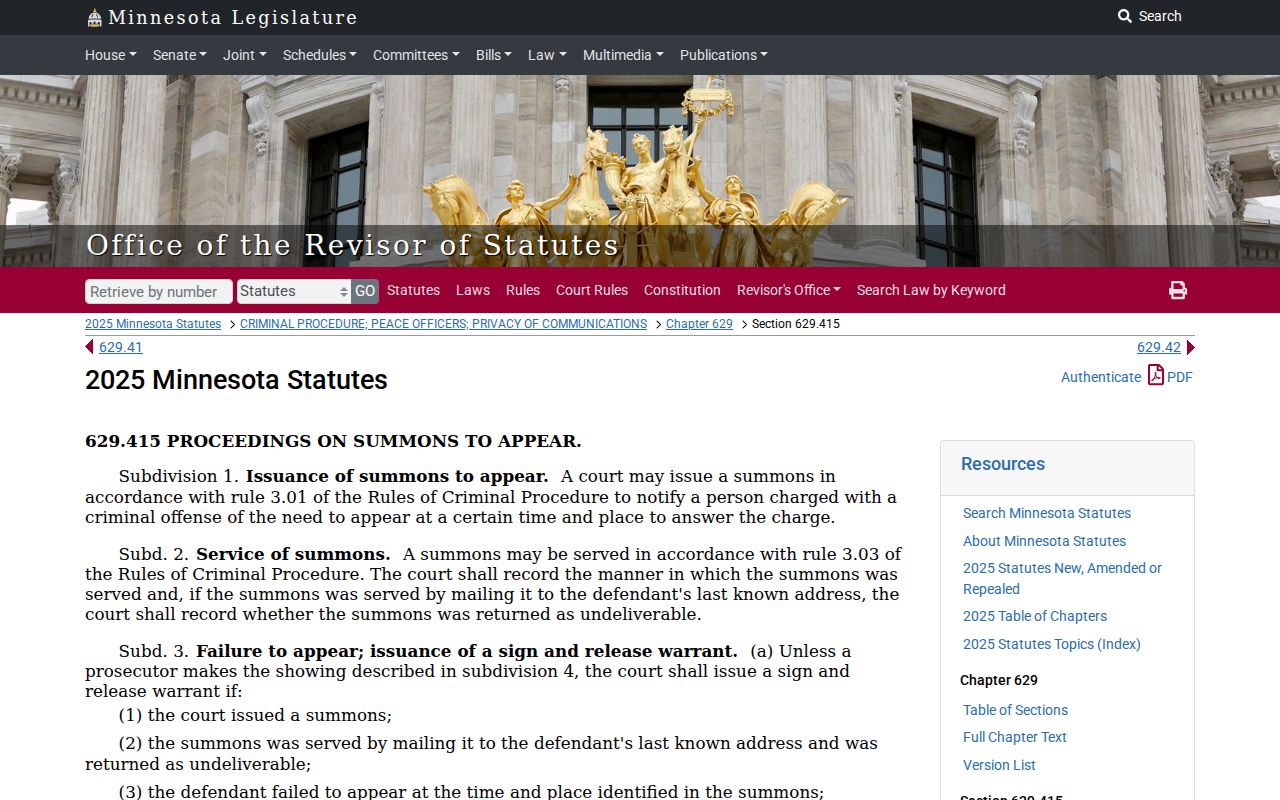
Minnesota offers a middle path for some missed summonses. Under the sign-and-release statute, a court can issue a warrant that authorizes no arrest. An officer simply hands the person notice of the missed appearance and a new date. It is still a court process, not immunity, and the case stays open. Minn. Stat. § 629.415 sets the conditions for that notice route and states plainly that it does not authorize arrest.
Even when a Cook County record carries the sign-and-release label, confirm the current expectation with the court. Assume nothing is required and you may guess wrong.
Bench Warrants and Arrest Warrants Compared
The two instruments look alike on a Cook County case screen. In practice they behave differently. One enforces a court obligation; the other starts a criminal case.
| Point | Bench or FTA warrant | Arrest warrant |
|---|---|---|
| What starts it | A missed appearance or condition | A complaint with probable cause |
| What it enforces | An existing case obligation | A new or pending criminal charge |
| Who signs it | Cook County district judge | Cook County district judge |
| Typical fix | A new date, a motion, or a bond | Appearance, counsel, and release terms |
A Cook County case history can carry both labels over time. The newest event, not the oldest, answers the question.
Cook County Warrants and the Ten-Day Rule
Minnesota treats some petty misdemeanors differently. For certain offenses, the law gives a person ten days to appear and show circumstances beyond their control before the failure-to-appear consequence applies. That window is narrow and tied to specific offenses, not a general grace period for every missed date. Minn. Stat. § 609.491 sets the ten-day opportunity and should be read alongside the citation and any court notice. For more serious offenses the failure-to-appear statute controls instead, and a lawyer should read the case before the person decides how to respond.
Resolving a Cook County Bench Warrant
A Cook County bench warrant gets resolved by the issuing court, not the jail and not a payment page. Paying a citation does not recall it. The county publishes no online recall form, amnesty calendar, or standard bond amount.
Do not ignore it: A bench warrant can be executed during any police contact, and an unordered walk-in can end in custody, so ask the court what it expects first.
- Find the case file or citation number.
- Read the register of actions, not just the result header.
- Call Cook County Court Administration if the case is pending or restricted.
- Ask whether the court wants a motion, an appearance, a new date, or a bond.
- Ask the sheriff separately about service and custody logistics.
- Confirm the recall or new appearance in the record afterward.
The Cook County warrant overview covers the same resolution paths. It applies when the instrument turns out to be an arrest warrant instead.
Cook County Warrant Calendars Miss Some Cases
The weekly Cook County court calendar is public and useful, but it is not a warrant list. The Judicial Branch posts it at 7 a.m. each business day and updates it hourly. Confidential matters are excluded, and a missing entry does not mean a hearing was cancelled. The Minnesota Judicial Branch Cook County court page publishes the calendar, the courthouse address, parking notes, and the public records route. When the two disagree, treat the printed calendar at the courthouse as the more current copy.
Finding the Court That Issued the Warrant
Every Cook County bench warrant trace leads to one place: the Cook County District Court in Grand Marais, part of the Sixth Judicial District. The county's official directories list no municipal criminal court, justice-of-the-peace court, or city marshal. Grand Marais city pages show no court or warrant counter either.
| Office | Role in a bench warrant | Contact |
|---|---|---|
| Cook County District Court | Issues and recalls the warrant | 411 W 2nd Street, Grand Marais; 218-264-7001 |
| Cook County Court Administration | Keeps the case record and public terminal | Business hours Monday through Friday |
| Cook County Sheriff | Serves process and handles custody | 143 Gunflint Trail; 218-387-3030 |
| Grand Marais City Hall | No court or warrant role | 15 N Broadway; 218-387-1848 |
That is the whole local map, which simplifies the routing question.
Cook County Warrant Workshop and Surrender
Cook County has shown that turning yourself in on a warrant can work. In 2024, a warrant-resolution workshop tied to the Cook County Shore Substance Use Recovery Court recorded a participant with an arrest warrant who came in voluntarily. The recovery court opened in 2016. Its program runs about 15 to 24 months of treatment, supervision, and judicial oversight, which is why the workshop was connected to it. Cook County recovery court news describes both the program and the workshop, though it does not name the participant. Treat that event as proof that surrender is possible. It is not a schedule. Cook County runs no standing amnesty or recurring workshop, so current details must come from the court itself. Court staff can explain the process. A lawyer can explain the risk, which is a different conversation worth having.